
How We Rebuild and Test a Network Switch Before It Ships
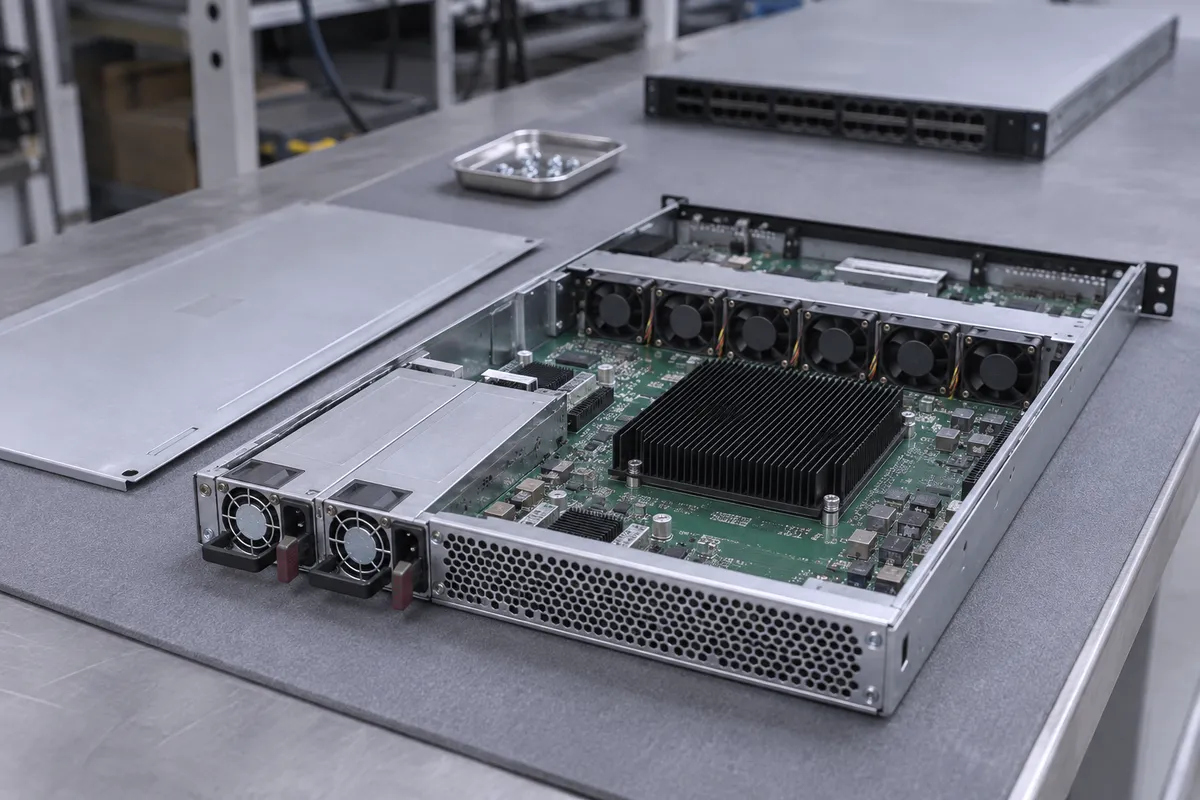
Every switch we ship goes through four stages: intake, recovery, build and final test. The final test checks power supply and fan status, airflow against the part number, port health, firmware and the management interface. This post is for network and procurement teams who buy refurbished switches and want to know what happens to a unit before it reaches them, and what to ask any supplier.
Stage 1: Intake – where the hardware comes from
We buy unused or discarded electronics from mid-size and large companies. Much of it is data-center hardware retired on a refresh schedule. By our own estimate, about 95% of our raw material is end-of-life electronics, possibly more. The rest, such as new components and consumables, we buy from suppliers.
Intake has four steps:
- Sourcing: retired equipment is bought in.
- Receiving: it arrives as raw material, not as finished stock.
- Sorting and cataloguing: each item is identified and logged against our database of part numbers, firmware versions, airflow variants and repair records.
- Inspection: items are checked for damage and sorted into four recovery lanes.
Stage 2: Recovery – four lanes
A switch is not recovered as one piece. Each part type has its own recovery path.
| Lane | What happens to it |
|---|---|
| Boards and cards | Repairable cards are repaired and rebuilt. Cards that cannot be repaired give their working components to other cards. Motherboards, CPUs and memory are recovered for use in switches. |
| Chassis | Chassis from scrapped switches are metal-worked, finished and repainted. |
| Power supplies and fans | Refurbished and remanufactured, so each switch gets the power and airflow its order specifies. |
| Cables | SFP, QSFP, QSFP56 and QSFP112 connectors and copper or fiber cable are recovered from cable sent for recycling. |
Stage 3: Build – to the bill of materials and your work order
Each switch is assembled to its bill of materials and the customer's work order. For switches, that means the airflow direction, the power supplies and the fans are set per order. Then compatible firmware and the correct operating system are loaded. Our database and AI tools support that selection.
Airflow matters more than most buyers expect. NVIDIA's SN2000 manual defines two directions. Power-to-connector (P2C) takes air in at the power side and exhausts it at the connector side. Connector-to-power (C2P) is the reverse. In NVIDIA part numbers, the "F" variant is P2C and the "R" variant is C2P, for example MSN2700-CS2F and MSN2700-CS2R.
Stage 4: Final test – what every switch is checked for
Every unit is tested before it ships. For switches, the final test covers:
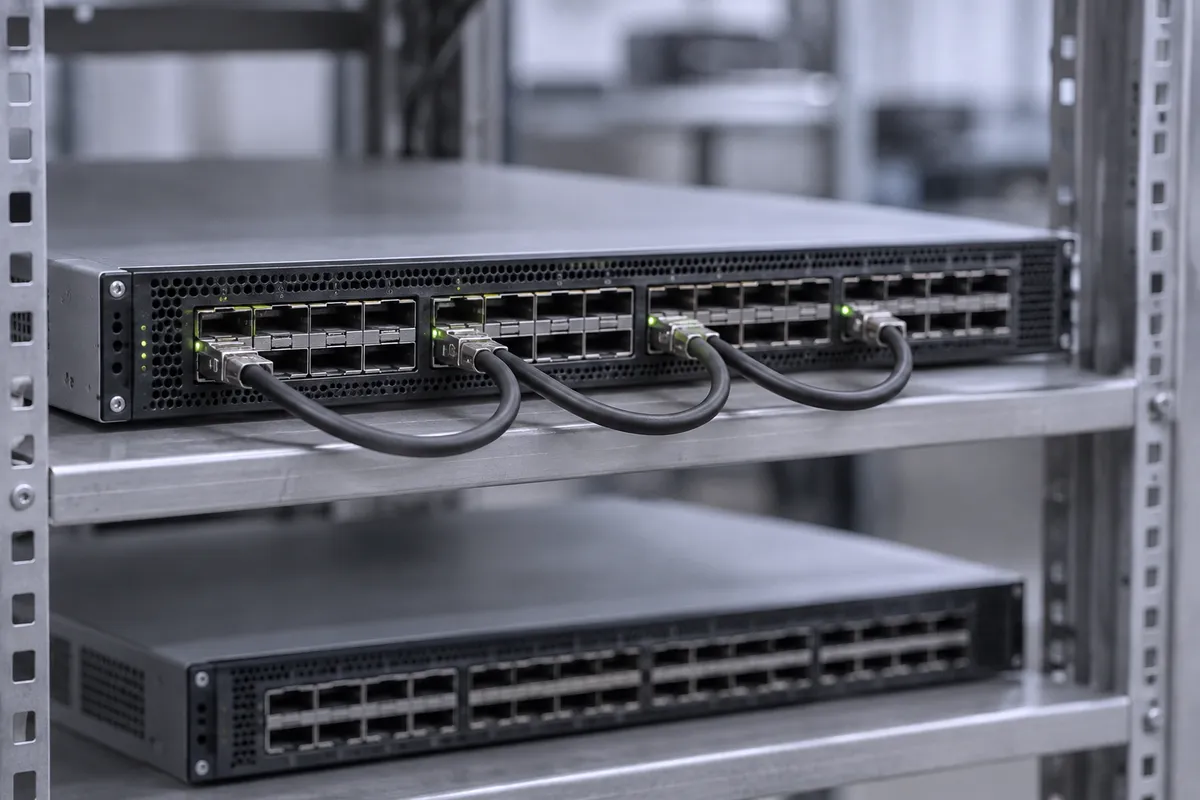
- Power supply and fan status.
- Airflow, checked against the part number.
- Port inspection and health.
- Firmware and management interface.
- Link test, where a test setup exists for that model.
The full process, including the adapter card and cable tests, is on our How We Build page. The sourcing side is on Remanufacturing.
What you receive
- A tested switch built to your work order, shipped worldwide.
- Enterprise-grade networking built to your specification, at a fraction of the cost of new equipment.
- A supplier that can still build products the original maker has stopped making. NVIDIA lists the MSN2700-CS2F, MSN2100-CB2F and MSB7800-ES2F as EOL and no longer available for ordering.
We are an independent manufacturer. We are not affiliated with or authorized by the original equipment makers. NVIDIA and Mellanox are trademarks of NVIDIA Corporation.
Common mistakes when ordering a refurbished switch
- Mixing airflow directions in one rack. NVIDIA states that all systems in the same rack should be planned with the same airflow direction, and that a mismatch affects heat dissipation.
- Mixing airflow inside one switch. NVIDIA states that all FRU components (power supplies and fans) need the same airflow direction.
- Assuming fans can be swapped later on every model. On the SN2100, NVIDIA's manual notes the fan units are not replaceable. Choose the airflow when you order.
- Ordering an InfiniBand switch for an Ethernet fabric. The MQM8700 (Quantum HDR) and MSB7800 (Switch-IB 2 EDR) are InfiniBand switches. The SN2700 and SN2100 are Spectrum Ethernet switches.
Questions to ask any refurbished-switch supplier
Use this checklist with any supplier, including us. It is general buyer guidance, not a description of any one supplier's process.
| Ask | Why it matters |
|---|---|
| Was every port inspected, and was a link test run on this model? | A switch that powers on can still have a dead or weak port. |
| Were both power supplies and all fans checked under power? | A failed redundant PSU or fan may not show until load or heat rises. |
| Does the airflow match the part number (F = P2C, R = C2P)? | The wrong direction fights the rack's hot and cold aisles. |
| Which firmware version and operating system are loaded? | You need a version your fabric and tools support. |
| Was the management interface tested? | Without working management access, you cannot configure the switch. |
| Does the label part number match the unit's identity? | Mixed or relabeled parts cause compatibility surprises. |
| What is the return policy if the unit fails on arrival? | Know the terms before the switch is in your rack. |
Parts we stock
Parts in this post
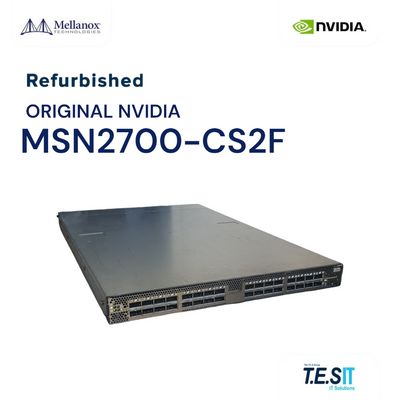 NVIDIA Mellanox MSN2700-CS2F 100GbE 32x QSFP28 Spectrum Switch OnyxMSN2700-CS2FView part
 NVIDIA Mellanox MSN2100-CB2F SN2100 16x 100GbE QSFP28 Half-Width Switch P2CMSN2100-CB2FView part
 NVIDIA Mellanox MQM8700-HS2F Quantum HDR 200Gb/s Switch 40-Port QSFP56 P2CMQM8700-HS2FView part
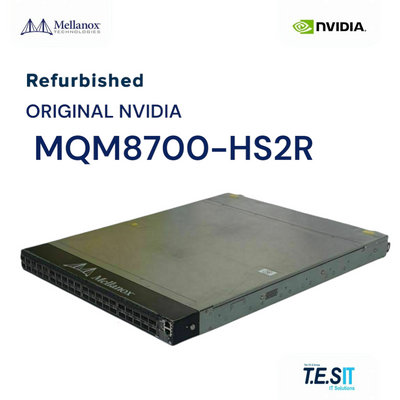 NVIDIA Mellanox MQM8700-HS2R Quantum HDR Managed IB Switch 40P QSFP56MQM8700-HS2RView part
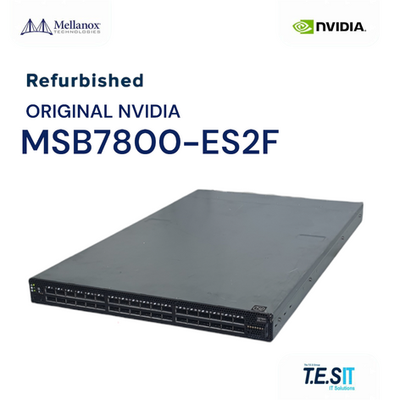 NVIDIA Mellanox MSB7800-ES2F Switch-IB 2 EDR 36-Port 1U Switch P2CMSB7800-ES2FView part
 NVIDIA Mellanox MSB7800-ES2R EDR 100Gb/s 36-Port QSFP28 Managed IB SwitchMSB7800-ES2RView part
- NVIDIA Mellanox MSN2700-CS2F: 32 QSFP28 ports at 100GbE, P2C airflow.
- NVIDIA Mellanox MSN2700-CS2R: 32 QSFP28 ports at 100GbE, C2P airflow.
- NVIDIA Mellanox MSN2100-CB2F: 16 QSFP28 ports at 100GbE, P2C airflow.
- NVIDIA Mellanox MQM8700-HS2F: 40 QSFP56 ports, HDR 200Gb/s InfiniBand, P2C airflow.
- NVIDIA Mellanox MQM8700-HS2R: 40 QSFP56 ports, HDR 200Gb/s InfiniBand, C2P airflow.
- NVIDIA Mellanox MSB7800-ES2F: 36 QSFP28 ports, EDR 100Gb/s InfiniBand, P2C airflow.
- NVIDIA Mellanox MSB7800-ES2R: 36 QSFP28 ports, EDR 100Gb/s InfiniBand, C2P airflow.
See all models on our switches page.
FAQ
What does the final test on a rebuilt switch check?
Every switch T.E.S IT-SOLUTIONS ships is checked for power supply and fan status, airflow against the part number, port inspection and health, and firmware and management interface. A link test is added where a test setup exists for that model.
What do the F and R mean in MSN2700-CS2F and MSN2700-CS2R?
In NVIDIA part numbers, F is P2C airflow (power-side inlet, connector-side outlet) and R is C2P airflow (connector-side inlet, power-side outlet). Both the MSN2700-CS2F and MSN2700-CS2R have 32 QSFP28 ports at 100GbE.
Can I mix P2C and C2P switches in the same rack?
NVIDIA's SN2000 manual says all systems in the same rack should be planned with the same airflow direction, and all FRU components in a switch need the same direction. A mismatch affects heat dissipation, so order one airflow variant per rack.
Where does the hardware for a rebuilt switch come from?
About 95% of our raw material is end-of-life electronics, by our own estimate. Much of it is data-center hardware retired on refresh schedules by mid-size and large companies, which we sort into four recovery lanes before a switch is built.
Is the MQM8700-HS2F an Ethernet switch?
No. NVIDIA documents the MQM8700-HS2F as an HDR 200Gb/s InfiniBand switch with 40 QSFP56 ports. For a 100GbE Ethernet fabric, a Spectrum switch such as the MSN2700-CS2F with 32 QSFP28 ports is the Ethernet option.
Need a switch built to a specific airflow, OS or power setup? Send us the part number or the requirement.